Is Trend Still Your Friend?: A Microstructural Account of the Demise of Short-Term Trend-Following
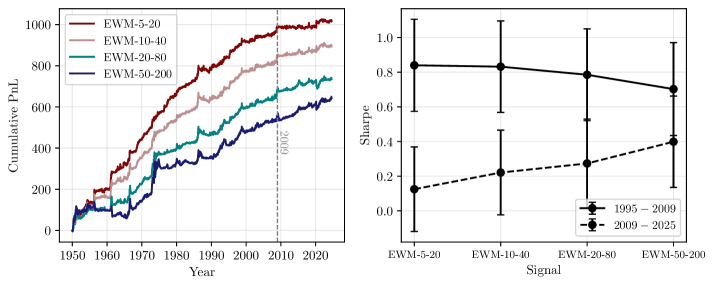
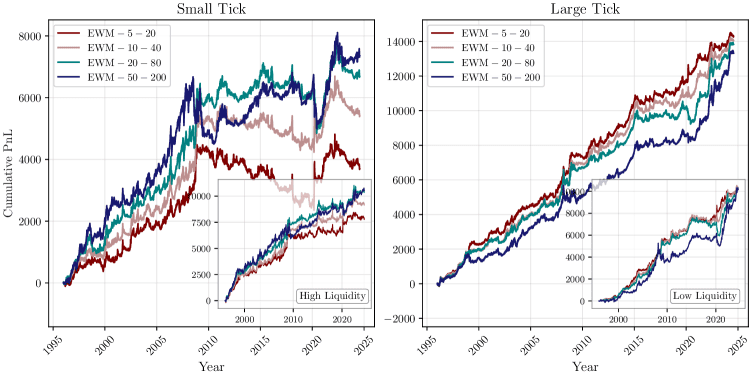
Trend following was one of the most persistent anomalies in finance for nearly two centuries, yet its performance deteriorated sharply after the 2008 financial crisis. An analysis of approximately 100 liquid futures contracts from 1995 to 2025 shows that this decline is highly selective. The decisive factor is not asset class, liquidity, market electronification, or strategy crowding, but volatility-normalized tick size. After 2008, trend-following profits collapsed almost entirely on small-tick contracts across all signal horizons, while remaining largely intact on large-tick contracts. This finding suggests that modern trend-following portfolios are fundamentally split into two distinct regimes governed by market microstructure rather than traditional asset classifications.
The recent paper by Kurth, Fisler, Rej and Bouchaud argues that trend following is sustained by a self-reinforcing feedback loop. Trend signals generate directional trading, which moves prices through market impact, strengthens the original signal, and creates opportunities for subsequent trend followers. The persistence of trends and the profitability of trend-following therefore depend on the same mechanism: aggressive directional trading must be able to translate into meaningful price impact. When this impact channel weakens, both the trend signal and its associated alpha deteriorate.
The authors attribute the post-2008 breakdown to the rise of high-frequency market making. On small-tick contracts, where order books are dense and spreads are tight, HFT liquidity providers increasingly withdraw liquidity in response to predictable directional order flow, preventing trend followers from generating sufficient market impact. On large-tick contracts, where order books remain structurally sparser and residual depth persists, this feedback mechanism survives, allowing trend-following to remain profitable. The central implication is that the decline of trend following is not universal but microstructural: the strategy has become increasingly dependent on the tick-size characteristics of the markets in which it is deployed.
Authors: Jutta G. Kurth, Zoltan Eisler, Adam Rej, Jean-Philippe Bouchaud
Title: Is Trend Still Your Friend?: A Microstructural Account of the Demise of Short-Term Trend-Following
Link: https://arxiv.org/abs/2607.01550
Abstract:
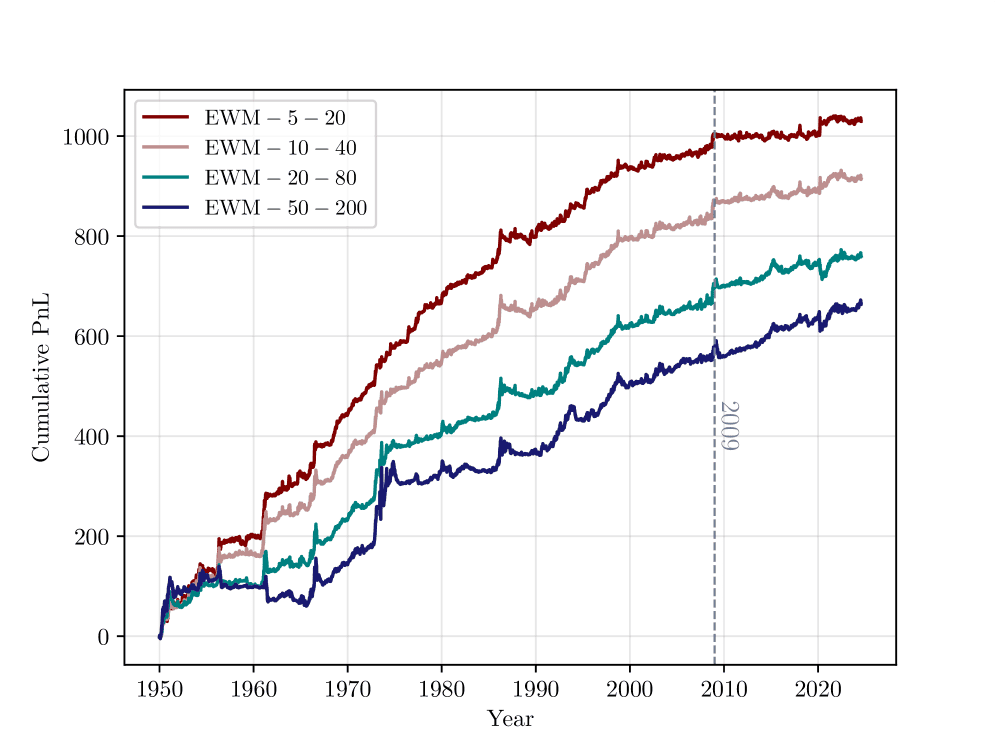
Systematic trend following has, on average, been profitable for at least two centuries; yet since approximately 2009, short-term trends have ceased to deliver reliable returns. Using a cross-section of roughly 100 liquid futures contracts spanning 1995-2025, together with an industry-representative CTA proxy, we document the break and characterise its dependence on signal speed and asset class. We evaluate four candidate explanations – capacity constraints, market electronification, a regime change in CTA-versus-order-flow interactions, and a microstructural mechanism – and find that the first three fail on grounds of timing, magnitude, or cross-sectional heterogeneity.
Our central empirical finding is that the cross-sectional variable distinguishing degraded from surviving trends is the volatility-normalised tick size: post-2008 trend PnL has collapsed on small-tick contracts across all signal horizons, while remaining essentially intact on large-tick ones. Neither asset class nor liquidity replicates this dichotomy.
We interpret this result through a self-fulfilling feedback loop that, in our view, lies at the heart of the trend anomaly itself: trend signals trigger directional trades, whose market impact reinforces the very price moves that generated the signal. Both the profitability and the persistence of trend are sustained by this impact channel, which requires that trend followers can execute aggressively at reasonable cost. We argue that the post-crisis transition to HFT-dominated market making, whose liquidity-withdrawal behaviour in front of predictable directional flow has sharply contrasting consequences for sparse (small-tick) and dense (large-tick) limit order books, has broken this loop on small-tick contracts. On large-tick contracts, residual depth remains sufficient, and the loop continues to operate.
As always, we present several interesting figures and tables:


Notable quotations from the academic research paper:
“Several stylised facts can be established and constrain any candidate explanation: (i) the break is abrupt, with the character of a structural regime shift rather than gradual alpha decay; (ii) it is speed-dependent, with fast signals (horizons of days to weeks) most affected whereas slow ones are approximately intact; (iii) it is asset-class heterogeneous, sparing yields and most commodities (in our universe) while strongly depressing equity indices and currencies; and (iv) there has been no recovery, despite material improvements in liquidity and declines in CTA participation since 2018.
The profitability of trend and its very existence are thus two faces of the same coin: both depend on aggressive directional flow being absorbable by the market at reasonable cost, so that impact translates trade into price and price into renewed signal. Anything that breaks this loop – by raising execution costs to the point of disengagement, or by altering the relationship between aggressive flow and price – should attack profitability and signal strength simultaneously. This is the lens through which we read the post-2008 evidence.
[…] The empirical observations we report below are therefore most naturally read as evidence that both the impact-loop and the anticipatory-trading components have been weakened in the post-2008 period, with the loop component decaying most visibly on small-tick contracts. We adopt the loop as our organising lens because it makes the cleanest predictions about the cross-section we study, not because we believe it is the only mechanism at work.
The interpretive frame we propose takes the self-fulfilling impact loop – signal trade impact reinforced signal – as the mechanism through which trend exists in the first place. Trend followers do not merely harvest a pre-existing anomaly: their aggressive directional flow, mediated by impact, sustains the very price patterns they trade on. The loop has two preconditions: that aggressive execution be feasible at reasonable cost, and that the relationship between aggressive flow and price remain intact. Both held until roughly 2010 across the futures universe; since then, both have been compromised on small-tick contracts and preserved on large-tick ones.
The contemporaneous return-versus-book-imbalance relationship makes the same story visible at intraday frequency. Its pre-2011 small-tick negative steepness measures the cost of providing depth in front of directional flow – exactly the cost the previous generation of market makers were absorbing. Its post-2011 flattening is the mechanical signature of liquidity withdrawal: depth that would have been run over no longer rests long enough to appear in the imbalance statistics.
Some practical implications follow. The break is structural; we see no plausible scenario in which it reverts absent a corresponding structural change in liquidity provision – whether through regulation, the entry of a new class of inventory-tolerant intermediaries, or a re-tariffing of market-making rents. Switching from aggressive to passive execution is not an option: passive execution incurs opportunity costs and forfeits the self-reinforcement channel that sustains the signal. Capacity estimation for trend portfolios should accordingly be carried out at the tick-size-tier level rather than at the asset-class level; aggregate participation rates can be substantially below historical bounds while still being binding within the small-tick subset.”
Are you looking for more strategies to read about? Sign up for our newsletter or visit our Blog or Screener.
Do you want to learn more about Quantpedia Premium service? Check how Quantpedia works, our mission and Premium pricing offer.
Do you want to learn more about Quantpedia Pro service? Check its description, watch videos, review reporting capabilities and visit our pricing offer.
Do you want algorithmic access to the full Quantpedia database via the API? Subscribe to Quantpedia Pro, ask for an API key, and explore the in/out-of-sample statistics, source academic papers, and code snippets — ideal for quantitative research, systematic trading workflows, and AI model training.
Are you looking for historical data or backtesting platforms? Check our list of Algo Trading Discounts.
Or follow us on:
Facebook Group, Facebook Page, Telegram, Twitter, Linkedin, Medium or Youtube
Share onLinkedInTwitterFacebookRefer to a friend