Commodity Crisis Analysis – How Portfolios React to Commodity Shocks
Introduction
Financial markets are often viewed primarily through lens of equity index movements, as they attract most of the attention. However, commodities represent an important component of the global economy, and shocks in commodity markets can have a significant impact on broader financial assets.
From time to time, market stress originates outside equities. A recent example are the repeated US attacks on Iran, which increased uncertainty in energy markets and raised the risk of an oil supply shocks. A similar dynamic was observed in 2022 during the Russian invasion of Ukraine, when commodity prices moved sharply higher or during the US invasion of Iraq in 2002, when uncertainty in oil markets led to increased price volatility.
These events highlight the importance of analyzing portfolio behavior not only during equity bull and bear markets, but also during commodity-driven shocks.
Commodity Crisis Analysis Framework
The Quantpedia Commodity Crisis Analysis report allows investors to evaluate how portfolios behave during selected historical commodity scenarios. These scenarios include both positive shocks, characterized by rising commodity prices, and negative shocks driven by weak demand or oversupply.
The scenario database includes both negative and positive commodity shocks, each representing a specific macroeconomic or geopolitical environment.
Negative commodity scenarios include:
- Tech Bubble 2000
- Debt Crisis 2008
- Gold Price Fall 2012
- Commodity Market Price Shock 2014
- Growth Slowdown 2014–2016
- Covid Breakout 2020
Positive commodity scenarios include:
- Oil and Uranium Run-Up 2001
- Iraq Invasion 2002
- Commodities Price Hike 2007
- Debt Crisis Recovery 2010
- Post-Covid Shock 2020
- Commodities during War in Ukraine 2022
For illustration, we use:
- Benchmark: SPY
- Model portfolio: XLE
This setup allows us to compare a broad equity market portfolio with a sector directly linked to commodity prices. How does a scenario analysis look like? We can run one simulation on past data …
Scenario Analysis
Commodities Price Hike 2007
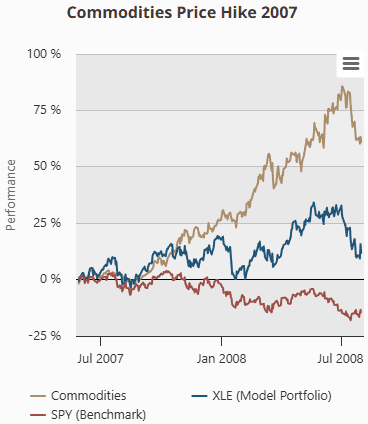
The period between 2007 and 2008 was characterized by strong growth in commodity prices driven by rising global demand, particularly from China. Expanding industrial activity supported higher prices across energy and metals, with oil prices increasing sharply during this period. This created a favorable environment for commodity-linked sectors.
The energy sector (XLE) delivered positive performance as rising commodity prices translated into higher revenues. However, the SPY benchmark lagged and eventually turned negative as the global financial crisis started to impact equity markets. This scenario shows how inflationary commodity shocks can benefit sector-specific portfolios while weighing on broader equities.
Commodities during War in Ukraine 2022
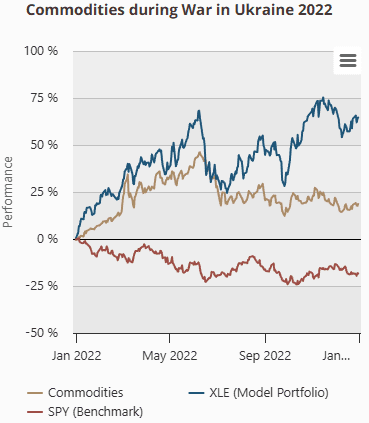
The Russian invasion of Ukraine in 2022 disrupted global commodity markets, especially energy. Supply uncertainty pushed prices higher, with a strong impact on oil and gas markets.
The energy sector (XLE) benefited from rising prices and delivered strong gains. In contrast, the SPY benchmark declined due to inflation pressures and tightening financial conditions. This period represents one of the largest divergences between the SPY benchmark and the XLE model portfolio.
Growth Slowdown 2014–2016
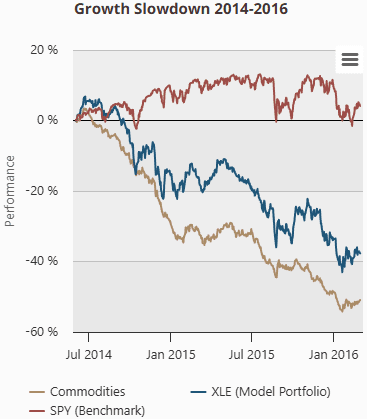
The decline in commodity prices starting in 2014 was driven by slowing global demand and continued supply expansion. Lower growth in emerging markets reduced demand for industrial commodities, while production remained elevated.
The energy sector (XLE) underperformed significantly due to its exposure to falling commodity prices. The SPY benchmark remained relatively stable and delivered modest positive performance over the same period. This scenario highlights how commodity deflation can negatively impact sector-focused portfolios while having a smaller effect on diversified equity exposure.
Covid Breakout 2020

The initial phase of the COVID-19 pandemic led to a sharp decline in global economic activity. Lockdowns and reduced mobility caused a significant drop in demand, especially for commodities.
Both commodities and the energy sector (XLE) experienced large drawdowns, with XLE declining more sharply due to its direct exposure to energy demand. The SPY benchmark also declined, but to a lesser extent. This scenario shows how demand shocks can disproportionately affect commodity-linked sectors.
Post-Covid Shock 2020
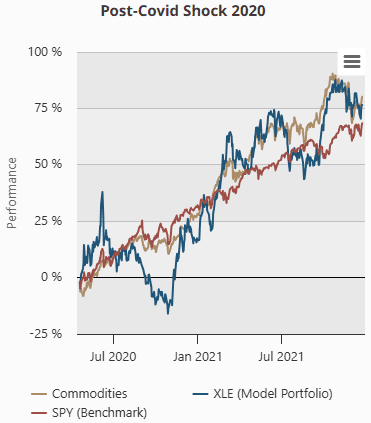
Following the initial pandemic shock, global markets entered a recovery phase supported by fiscal and monetary stimulus. Demand for commodities increased, leading to a strong rise in prices, particularly in energy.
The energy sector (XLE) delivered strong gains and outperformed the broader market. The SPY benchmark also recovered, but its performance was less directly linked to commodity price movements. This scenario illustrates how reflationary environments tend to favor commodity-exposed portfolios.
Conclusion
Portfolio performance can vary significantly depending on the underlying macroeconomic environment. Commodity shocks represent an important source of risk that is often not captured by standard equity-focused analysis.
A portfolio that performs well during typical equity market conditions may still be exposed to commodity-related risks, such as energy price movements or changes in global demand. Therefore, it is useful to complement traditional equity crisis analysis with scenario-based analysis focused on commodity markets.
The Commodity Crisis Analysis report provides a practical framework for identifying these sensitivities and understanding how different portfolios behave across a range of commodity-driven environments.
Author: David Mesicek, Junior Quant Analyst, Quantpedia
Are you looking for more strategies to read about? Sign up for our newsletter or visit our Blog or Screener.
Do you want to learn more about Quantpedia Premium service? Check how Quantpedia works, our mission and Premium pricing offer.
Do you want to learn more about Quantpedia Pro service? Check its description, watch videos, review reporting capabilities and visit our pricing offer.
Do you want algorithmic access to the full Quantpedia database via the API? Subscribe to Quantpedia Pro, ask for an API key, and explore the in/out-of-sample statistics, source academic papers, and code snippets — ideal for quantitative research, systematic trading workflows, and AI model training.
Are you looking for historical data or backtesting platforms? Check our list of Algo Trading Discounts.
Or follow us on:
Facebook Group, Facebook Page, Telegram, Twitter, Linkedin, Medium or Youtube
Share onLinkedInTwitterFacebookRefer to a friend