Is The Optimal Long-term Portfolio Share of Bitcoin Negative?
The crypto-enthusiast’s mantra—“just add Bitcoin and watch the efficient frontier fly”—runs into a hard empirical wall when you extend the sample, tighten the econometrics, and force the asset to compete on identical risk-adjusted footing with equities. Alistair Milne’s new SSRN paper applies a textbook Markowitz mean–variance framework to a two-asset universe (S&P 500 vs. Bitcoin) and finds that the ex-ante optimal long-term weight on BTC is not merely small; it is outright negative (–1.6 % over 2014-2025, –7.3 % using only recent data). In other words, a rational, variance-averse allocator who believes expected returns equal historical equity premia plus a fair compensation for BTC’s non-diversifiable volatility should be short, not long, the flagship digital token. This post is in response to our ‘How Much Bitcoin Should We Allocate to the Portfolio?‘ article, which will provide a look at the topic from a different lens and broaden perspectives.
Why the inversion of the usual “diversification” narrative? Two structural shifts dominate Milne’s diagnostics:
- The time-varying correlation between BTC and U.S. equities has pivoted from weakly negative to persistently positive in the post-COVID regime, annihilating any covariance-driven hedging edge.
- Stochastic discount factor logic implies that, absent a credible cash-flow anchor, the expected real return on a pure-play digital bearer asset is capped by its convenience yield, effectively zero, leaving the heavy tail risk uncompensated.
Together, these properties collapse Bitcoin’s Sharpe ratio relative to plain-vanilla equities, pushing the efficient frontier back toward the canonical stock-bond line. Milne, therefore, concludes that BTC’s enduring investment case is strictly “for speculation,” not for strategic asset allocation.
For practitioners, the paper presents an invitation to critically examine the assumptions underlying passive crypto portfolio studies—most notably, short sample windows, rebalancing heuristics that exploit realized volatility, and the implicit assumption that “upside optionality” is a free lunch. Stripped of those conveniences, Bitcoin’s risk budget overwhelms its marginal contribution to portfolio utility.
Authors: Alistair Milne
Title: The Optimal Long-term Portfolio Share of Bitcoin is Negative (or Zero)
Link: https://papers.ssrn.com/sol3/papers.cfm?abstract_id=5176989
Abstract:
Applying the standard Markovitz mean-variance framework to a two asset portfolio consisting of US stocks (S&P500) and Bitcoin (BTC), challenges the notion that BTC offers diversification benefits for long-term investors. With risk (variance and covariance) estimated using data from 02/14 to 02/25 and long-term returns based on standard efficient markets assumptions, the optimal portfolio share for Bitcoin-1.6% (full sample) and-7.3% (recent sample), regardless of investor preferences towards risk. Other contributions on BTC in portfolio management report that a positive BTC portfolio share improves risk-return trade-offs. This difference is explained by their focus on short-term dynamic asset allocation strategies and the more recent data used here, exhibiting an increased +ve correlation between BTC and stock returns. This suggests that BTC is only of interest for speculation and long-term returns to the crypto industry only from the facilitation of this gambling.
As continuously, we present several interesting figures and tables:

Notable quotations from the academic research paper:
“Figure 1 displays the two price series, employing logarithmic scales to highlight their growth and co-movements.
In the earlier years of the sample =, from 2014 to 2017, there is little indication of co-movements of the S&P500 composite index and the price of Bitcoin. Thereafter there are increasing indications of co-movement: during the rapid rise of BTC in 2017; with the fall of asset prices at the onset of the Covid-19 pandemic and during their subsequent recovery; and during the sharp post-pandemic rise and subsequent fall in inflation. The ‘crypto winter’ of 2022 coincides with the consequent sharp rise of US dollar interest rates and US equity market price correction.
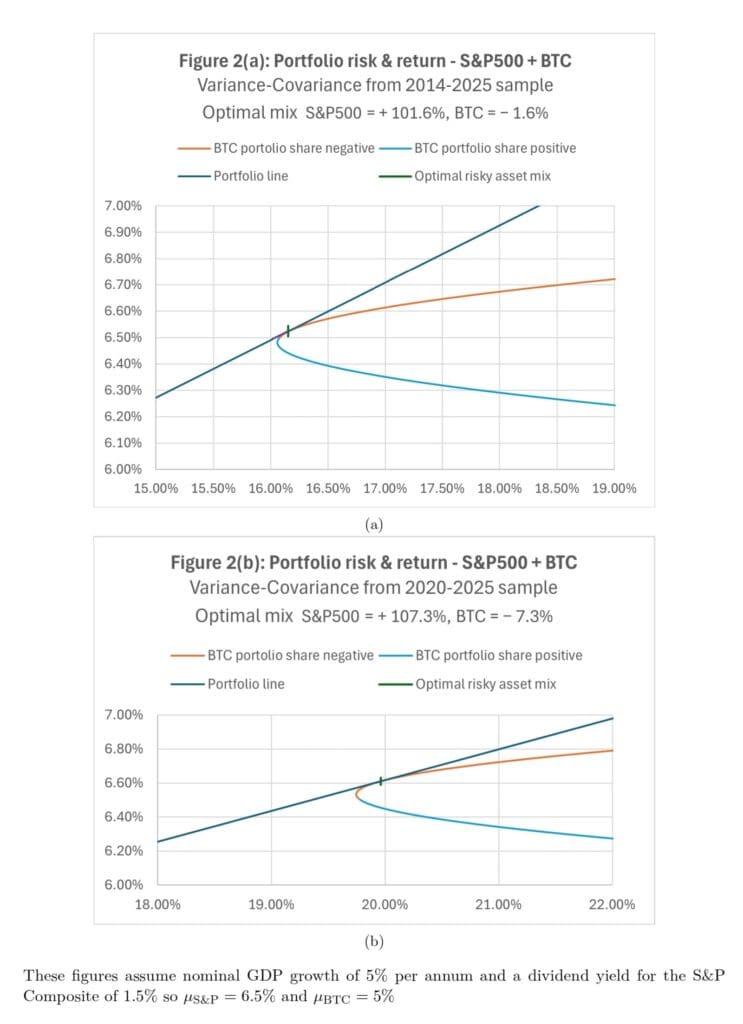
Figure 2 reports the resulting calculations of the optimal share of BTC in a BTC/S&P Portfolio.
For both cases, using the lower correlation and variances estimated for the period 2014-2025 and the higher correlation and variances for the period 2020-2025, the resulting optimal share of BTC is negative. In the first case the optimal share of BTC in the risky portfoilo is −1.6%; in the second case it is −7.3%. These findings can be understood using these standard risk-return diagrams: curved (parabolic) lines in the figures represent the combinations of risk (standard deviation) and return (expected return) achieved with different proportions of the S&P500Comp and BTC in the portfolio.
his paper employs the standard Markowitz 1952 model of mean-variance portfolio optimization to compute the optimal share of Bitcoin when combined with exposure to equities (the S&P500) and a risk-free asset in long-term portfolio allocation. With variance-covariances estimated on daily data this finds that the appropriate share is negative, both when the data used for estimation is for 2014-2025 (Figure 1, share -1.6%) and 2020-2025 (Figure 2, share -7.30%).
The analysis here provides no grounds for believing that Bitcoin or other digital assets offer any improvement in risk-return tradeoffs for long-term investors. The gains on offer to investors from crypto-technologies are almost entirely of the first kind, lowering the operational costs of invest- ment and reducing barriers to entry in the provision of investment services. The only long-term investment opportunities from cryptoassetsis those from meeting the speculative demand for gam- bling in Bitcoin and other crypto assets. An historical analogy here is with the 1849 California gold rush: the only reliable way to make money – then and now – is through investment in the enterprises that facilitate speculation (selling miners picks and shovels; providing investors with access to crypto-trading) not from the speculation itself.”
Are you looking for more strategies to read about? Sign up for our newsletter or visit our Blog or Screener.
Do you want to learn more about Quantpedia Premium service? Check how Quantpedia works, our mission and Premium pricing offer.
Do you want to learn more about Quantpedia Pro service? Check its description, watch videos, review reporting capabilities and visit our pricing offer.
Are you looking for historical data or backtesting platforms? Check our list of Algo Trading Discounts.
Or follow us on:
Facebook Group, Facebook Page, Twitter, Linkedin, Medium or Youtube
Share onLinkedInTwitterFacebookRefer to a friend