Commodity Portfolio Strategy for a Potential 2026 Inflationary and Supply Shock Regime
Commodity markets are in the spotlight. Two factors currently stand out. Firstly, the geopolitical tensions, as ongoing instability in the Middle East continues to create uncertainty in energy markets, particularly on the supply side. Secondly, less discussed are climate conditions, as the El Niño–Southern Oscillation (ENSO) is a recurring climate cycle that affects temperature and precipitation patterns globally and has historically influenced agricultural yields and supply dynamics.
Together, these forces create a plausible environment for stronger commodity performance, or at least increased dispersion across individual commodities. Instead of expressing this view through a simple buy-and-hold allocation, we approach the problem as a systematic portfolio construction task.
Basic Portfolio Overview
So let’s start. We can construct a diversified basket of 10 commodity ETFs in Quantpedia’s Portfolio Analysis:
CANE (Teucrium Sugar Fund), CPER (United States Copper Index Fund), CORN (Teucrium Corn Fund), GLD (SPDR Gold Shares), PALL (Aberdeen Standard Physical Palladium Shares ETF), PPLT (Aberdeen Standard Physical Platinum Shares ETF), SLV (iShares Silver Trust), SOYB (Teucrium Soybean Fund), USO (United States Oil Fund), and WHEAT (Teucrium Wheat Fund)
Each ETF is equally weighted at 10%, providing exposure across agriculture, metals, and energy.
We begin with a simple equal-weighted allocation across all selected commodity ETFs. This baseline portfolio serves as a natural starting point before introducing any portfolio management techniques.
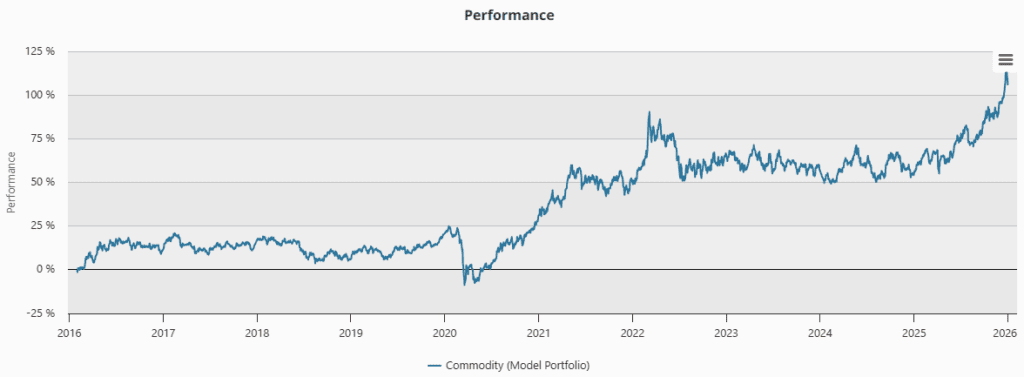
The performance profile reflects the cyclical nature of commodities. The portfolio captures long-term growth, but returns are uneven and heavily influenced by macro-driven regimes.
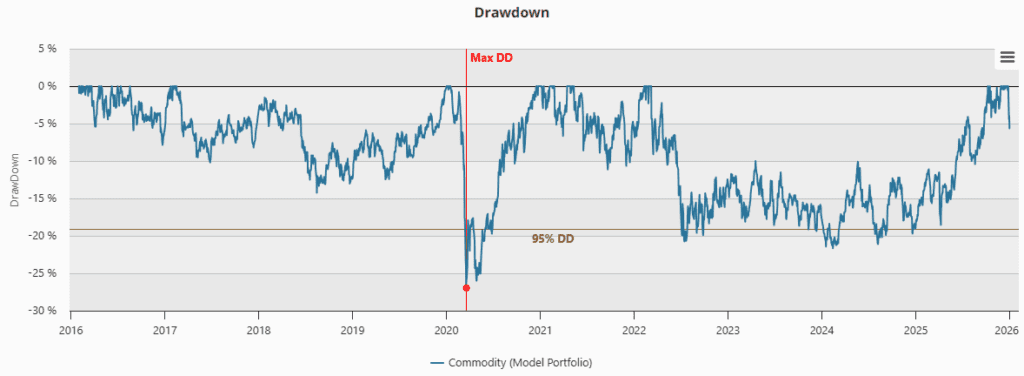
The drawdown curve highlights one of the main challenges of commodity investing. Even a diversified basket can experience significant losses, particularly during demand shocks or macro slowdowns.
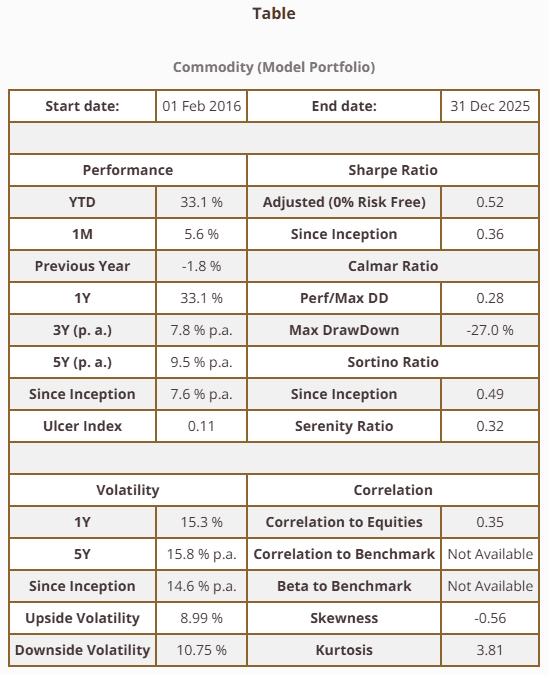
From a statistical perspective, the portfolio delivers moderate returns with relatively high volatility and drawdowns. This makes it a useful benchmark, but also clearly motivates the need for more advanced portfolio management techniques.
Cross-Sectional Momentum Management
Instead of holding all commodities at all times, let’s try something different – we can apply a cross-sectional momentum framework. This approach ranks ETFs based on past performance and allocates capital only to the strongest performers. Only in this case, we are not using the Quantpedia Pro Cross-Sectional Momentum report to rank strategies, but directly ranking ETFs within the commodity universe.
The 12-month lookback emerges as the most stable and intuitive specification, as commodity trends are typically driven by medium-term macro and supply-demand imbalances.
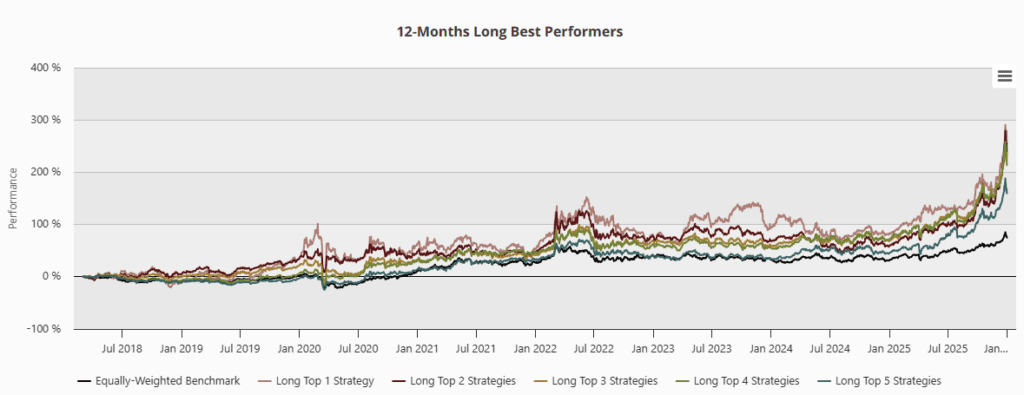
The equity curves show a clear improvement over the equal-weight benchmark. Concentrating capital into top-performing commodities enhances returns, especially during strong trending environments.
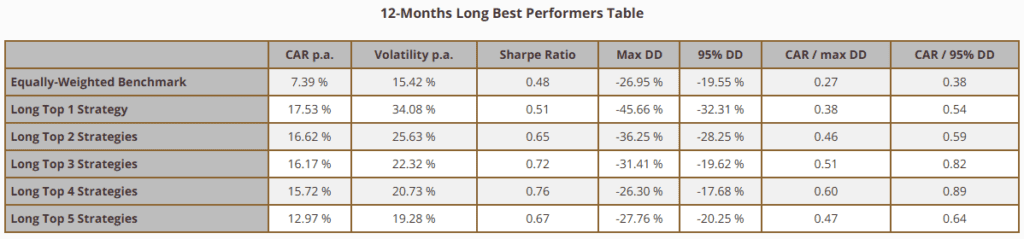
The results confirm that selecting a smaller subset of assets improves performance, although at the cost of higher volatility. The most balanced outcome is achieved when selecting approximately 3–4 commodities.
Time-Series Moving Average Management
We now shift from relative ranking to trend-following at the individual asset level.
Each ETF is evaluated independently using a moving average filter. When the price is above the moving average, the asset remains in the portfolio; otherwise, it is excluded.
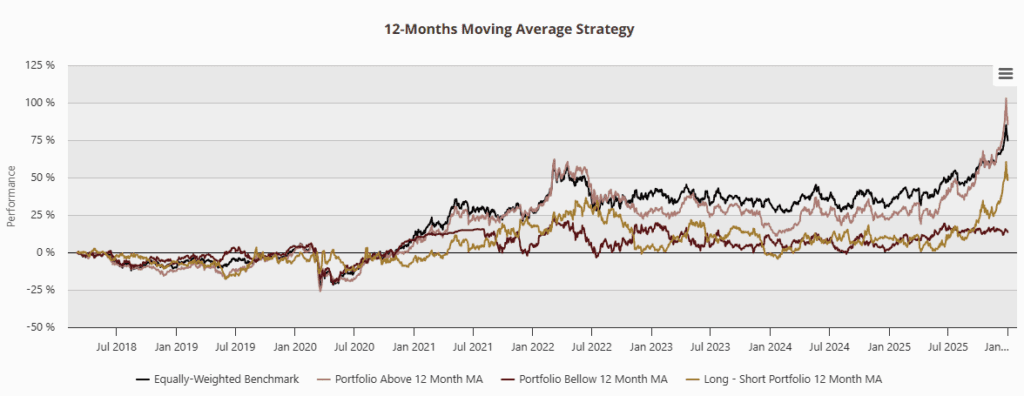
The moving average acts as a simple regime filter, helping to reduce exposure during prolonged downturns.
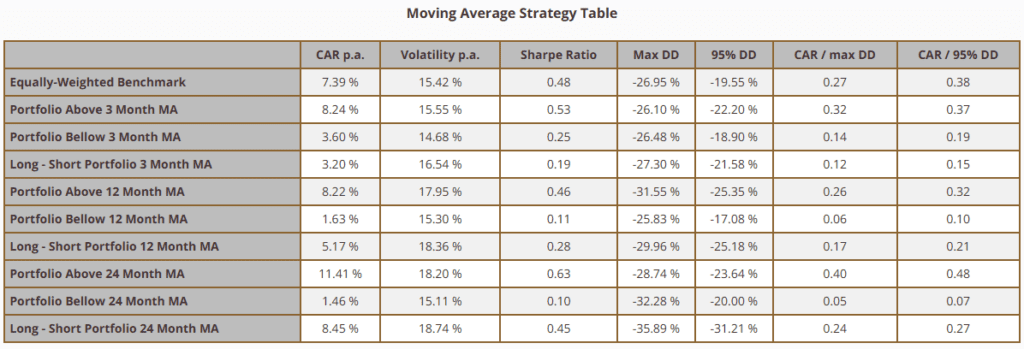
Longer-term filters generally perform better in terms of risk-adjusted returns. While the 24-month variant achieves the highest Sharpe ratio, the 12-month moving average offers a strong balance between responsiveness and stability.
Cross-Asset Volatility Targeting Management
A key issue in commodity portfolios is uneven volatility across assets.
Energy and metals can experience sharp volatility spikes, while agricultural commodities tend to be more stable. In an equal-weight portfolio, this leads to an imbalance where more volatile assets dominate overall risk.
To address this, we apply volatility targeting at the ETF level. Each ETF is scaled to a 10% volatility target before ranking and portfolio construction.
Equalizing the volatility contributions allows for the same chances for all ETFs to appear in the top or bottom portfolio based on their performance.
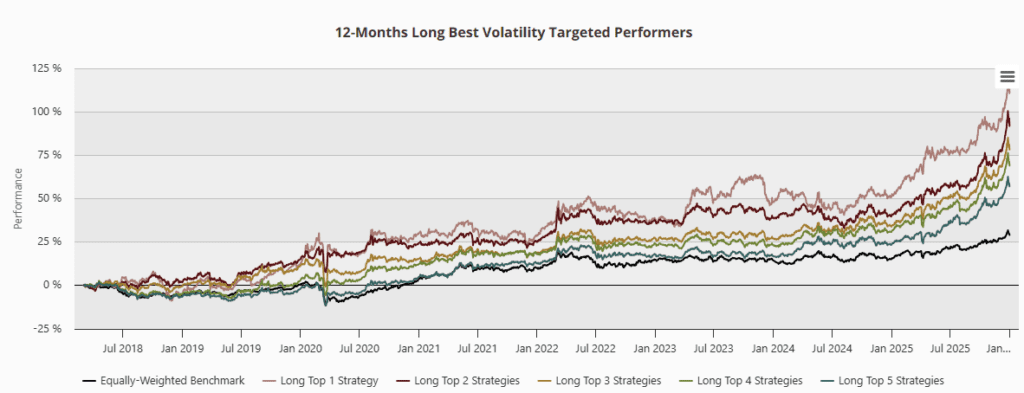
The effect is immediately visible. The equity curve becomes smoother while maintaining strong performance.
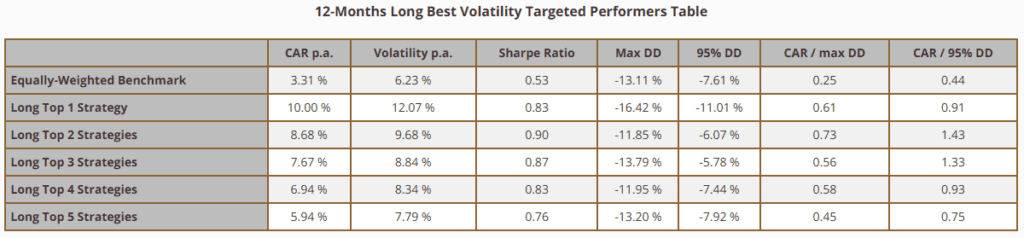
Volatility-targeted momentum delivers the strongest risk-adjusted results. Sharpe ratios improve, and drawdowns are more controlled, particularly when focusing on the top-performing assets.
Conclusion
As commodities enter a stronger macro regime in 2026, a passive allocation may not be the most efficient way to capture the opportunity. A systematic approach provides a more robust alternative.
The equal-weighted portfolio serves as a solid baseline, but its characteristics clearly highlight the need for improvement. Cross-sectional momentum helps concentrate capital in the strongest trends. Time-series moving averages reduce exposure during weaker periods. Volatility targeting ensures balanced risk contribution across assets. Across all tested approaches, the 12-month lookback consistently emerges as the most robust parameter. The strongest overall results are achieved by combining momentum with volatility targeting, offering the best balance between return, risk, and drawdown control.
Author: David Mesicek, Junior Quant Analyst, Quantpedia
Are you looking for more strategies to read about? Sign up for our newsletter or visit our Blog or Screener.
Do you want to learn more about Quantpedia Premium service? Check how Quantpedia works, our mission and Premium pricing offer.
Do you want to learn more about Quantpedia Pro service? Check its description, watch videos, review reporting capabilities and visit our pricing offer.
Do you want algorithmic access to the full Quantpedia database via the API? Subscribe to Quantpedia Pro, ask for an API key, and explore the in/out-of-sample statistics, source academic papers, and code snippets — ideal for quantitative research, systematic trading workflows, and AI model training.
Are you looking for historical data or backtesting platforms? Check our list of Algo Trading Discounts.
Or follow us on:
Facebook Group, Facebook Page, Telegram, Twitter, Linkedin, Medium or Youtube
Share onLinkedInTwitterFacebookRefer to a friend