Hello all,
Firstly, in this month’s update, we’d like to share one of our October additions to Quantpedia Pro tools. Our new Tax Analysis Report shows how much of a backtested portfolio’s performance could remain after taxes if the strategies were traded live. You can run the report on any Quantpedia strategy backtest, import your own QuantConnect backtest as a custom user curve, or combine both in a model portfolio.
The report calculates taxes on realized gains using three rates you can set independently. You can specify a short-term rate for positions held for less than 12 months, a long-term rate for positions held for more than 12 months, and a separate crypto tax rate. The report breaks down the portfolio’s short-term and long-term tax burden, shows the total, and tracks annual tax payments. For portfolios with multiple strategies, it also shows how much each strategy contributes to the overall tax bill.
The report compares gross and after-tax returns over time. It deducts each year’s taxes from the portfolio on March 31 of the following year, reducing the capital available for compounding. Capital losses expire at year-end for the purposes of the simulation.
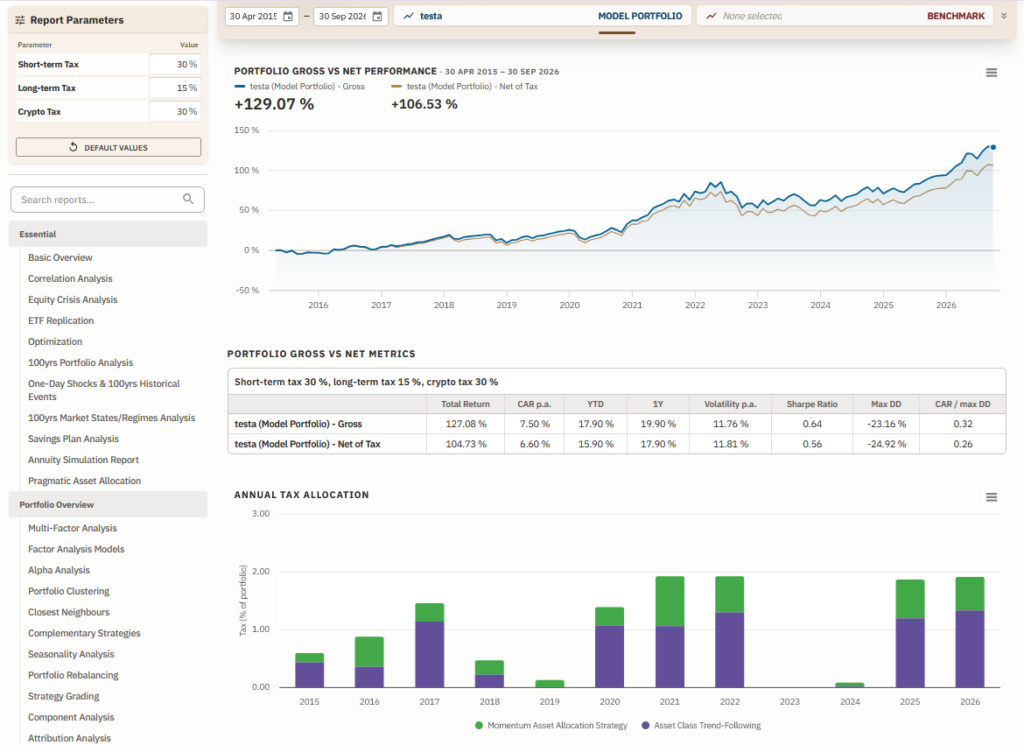
By comparing strategies under the same tax assumptions, you can see whether an edge in gross returns holds up after taxes and identify which strategies drive most of the portfolio’s tax burden.
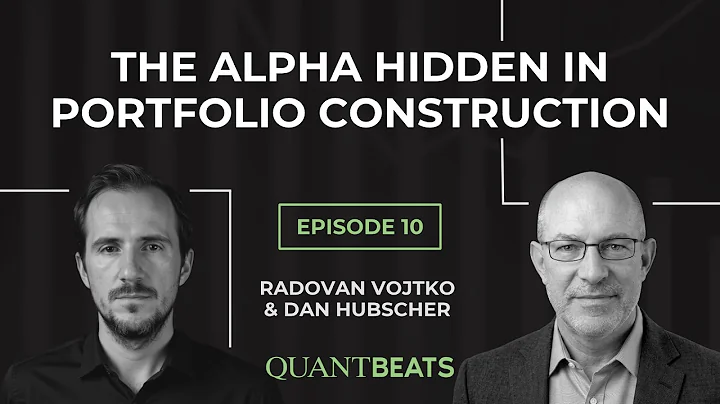
Secondly, we would like to invite you to watch the 10th episode of our YouTube video series QuantBeats with the subtitle The Alpha Hidden in Portfolio Construction. The episode explores what comes after finding alpha: building a portfolio that can navigate changing markets. We discuss why seemingly novel strategies can share familiar exposures, how diversification and crisis hedging shape portfolio construction, and why benchmarks and human judgment still matter in the age of AI …
Listen to this newest Quantbeats episode, and we also sincerely invite you all to follow us on our YouTube, Linkedin, FB, Twitter, and/or Bluesky links.
Thirdly, the time is ticking away, and the end of year 2026 is here very soon. Do not forget to join our race for Quantpedia Awards 2027 and a $25.000 prize pool, and if you can’t (or do not want to join), then please share the message around you.
Submit your quantitative investing paper to awards@quantpedia.com and give your research the recognition it deserves!

And finally, let’s also quickly recapitulate Quantpedia Premium development:
Additionally, 5 new research reviews were published on the Quantpedia blog in the previous month:
Does More History Help? A Market-Regime HMM and the Trouble with Out-of-Sample Evaluation
Author: Julian Jalsovsky
Title: Does More History Help? A Market-Regime HMM and the Trouble with Out-of-Sample Evaluation
Bitcoin Runs on a Clock: Why Every Price Indicator Dies and the Halving Clock Doesn’t
Author: Josh Molnar
Title: Bitcoin Runs on a Clock: Why Every Price Indicator Dies and the Halving Clock Doesn’t
Shorting Leveraged ETFs: The Role of Borrowing Costs and Rebalancing in Volatility-Decay Strategies
Author: David Belobrad
Title: Shorting Leveraged ETFs: The Role of Borrowing Costs and Rebalancing in Volatility-Decay Strategies
Custom Strategy Grading with Quantpedia API
Author: David Mesicek
Title: Custom Strategy Grading with Quantpedia API
Correlation Acceleration: Detecting Market Stress Through Rising ETF Correlations
Author: David Mesicek
Title: Correlation Acceleration: Detecting Market Stress Through Rising ETF Correlations
Yours …
Radovan Vojtko
CEO & Head of Research
Are you looking for more strategies to read about? Sign up for our newsletter or visit our Blog or Screener.
Do you want to learn more about Quantpedia Premium service? Check how Quantpedia works, our mission and Premium pricing offer.
Do you want to learn more about Quantpedia Pro service? Check its description, watch videos, review reporting capabilities and visit our pricing offer.
Do you want algorithmic access to the full Quantpedia database via the API? Subscribe to Quantpedia Pro, ask for an API key, and explore the in/out-of-sample statistics, source academic papers, and code snippets — ideal for quantitative research, systematic trading workflows, and AI model training.
Are you looking for historical data or backtesting platforms? Check our list of Algo Trading Discounts.
Or follow us on:
Facebook Group, Facebook Page, Telegram, Twitter, Linkedin, Medium or Youtube
Share onLinkedInTwitterFacebookRefer to a friend